
Moving abroad is rarely just about changing your address. It is about changing your rhythm, your daily habits, your relationship with space, time, food, work, and even the way you spend your weekends. When the journey takes you between France and the United States, the experience becomes even more meaningful: two countries, two lifestyles, two cultures, and countless small details that shape the way you feel at home.
Whether you are leaving a Parisian apartment for a house on the East Coast, relocating from the French Riviera to California, or returning to France after several years in the United States, the move often marks the beginning of a new chapter. The key is not only to transport your belongings, but also to prepare yourself for a different way of living.
For those who want practical support while keeping the experience smooth and personal, Transports-Mari offers international moving expertise that can help turn a complex relocation into a more manageable transition.
The Emotional Side of Living Between Two Cultures
A move between France and the USA often begins with excitement: new opportunities, new landscapes, new routines. But once the decision is made, emotions can become mixed. You may feel impatient to discover a new city while also wondering how you will adapt to everyday life.
France often brings to mind a slower pace, local markets, long meals, and compact city living. The USA is often associated with space, mobility, convenience, and a more flexible approach to daily life. Neither lifestyle is better than the other; they simply require different habits. Understanding that difference before you move can help you settle in with more ease.
Think of your relocation as a lifestyle transition rather than a logistical problem. What do you want your mornings to look like? How will you organize your home office? Which objects will make your new place feel familiar? These questions matter just as much as paperwork and packing lists.
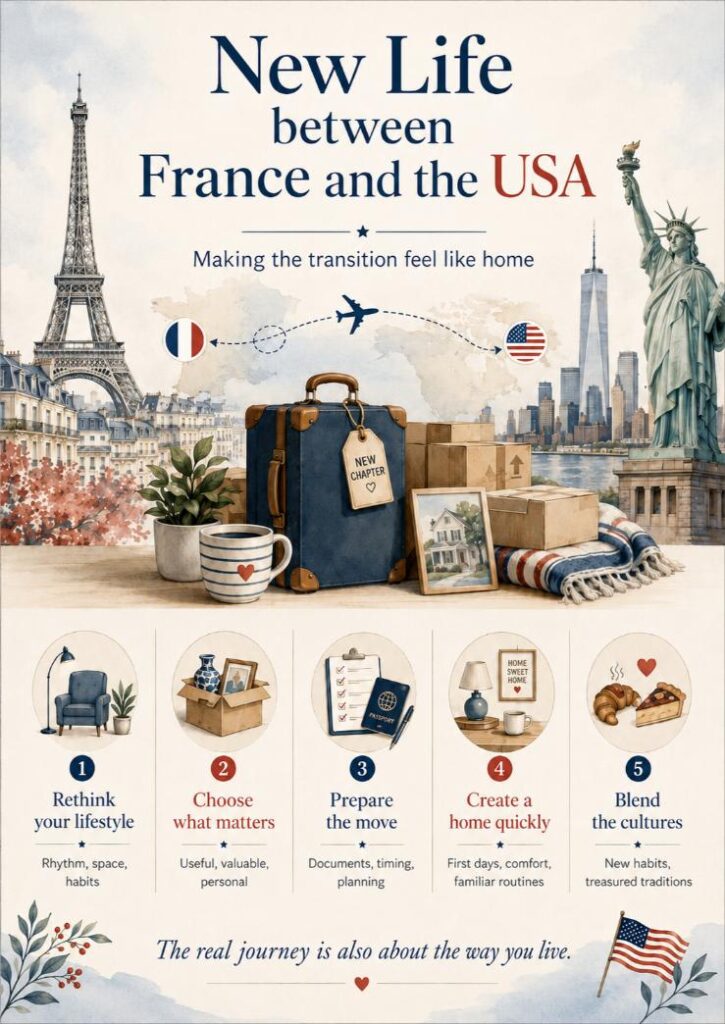
Choosing What Really Deserves to Travel With You
International moves are a perfect opportunity to rethink your relationship with your belongings. When you move across town, it is easy to pack everything. When you move across the Atlantic, every item deserves a little more thought.
Some objects are practical: furniture, clothes, kitchen equipment, books, work materials. Others carry emotional value: family pieces, artwork, photographs, a favorite armchair, children’s toys, or objects collected over the years. The best approach is to separate what is useful, what is meaningful, and what belongs to a life you are ready to leave behind.
A successful move is not necessarily about taking less. It is about taking better. The goal is to arrive with the objects that will help you feel grounded from the first weeks in your new environment.
Moving France-USA: The Practical Moment in a Lifestyle Journey
Even if the project feels personal and emotional, Moving France-USA also requires careful planning. This type of relocation involves long-distance transport, customs procedures, timing, packing standards, and coordination between departure and arrival points. Personal effects, furniture, fragile items, and valuable objects may all require different levels of preparation.
The earlier the move is organized, the easier it becomes to anticipate transit times, documentation, and delivery expectations, allowing the lifestyle change itself to remain the main focus.
Creating a Home Before You Fully Arrive
One of the most helpful things you can do before leaving is to imagine your first month in the new country. Where will you sleep the first night? What do you need immediately? Which boxes should be easy to identify? Which items will help you rebuild familiar routines quickly?
A home is not created all at once. It begins with small gestures: making coffee in your usual cup, placing books on a shelf, hanging a familiar picture, cooking a meal you know by heart. These details help reduce the feeling of distance and make a foreign place feel more personal.

When moving between France and the USA, it can also be useful to prepare a “first days” selection: documents, clothes, chargers, basic kitchen items, toiletries, children’s essentials, and anything needed for work. The more comfortable the first few days feel, the easier it is to enjoy the new beginning.
Adapting Your Lifestyle Without Losing Yourself
Relocation does not mean becoming someone else. It means learning how to live differently while keeping what matters to you. A French family moving to the USA may discover larger homes, longer drives, different school routines, and new social habits. An American moving to France may adapt to smaller spaces, local administration, neighborhood shops, and a different sense of time.
The most successful transitions are often made by people who stay curious. Instead of comparing everything, observe how daily life works. Try new habits, but keep your own rituals. Explore local culture, but continue the traditions that make you feel connected to where you come from.
In time, your life becomes a blend of both worlds. You may keep French dining habits in an American home, or bring an American sense of openness into a French neighborhood. That mix is often what makes international living so rewarding.
Turning Distance Into Opportunity
Living between France and the United States can reshape your perspective. You begin to understand that home is not only a location. It is a combination of people, memories, routines, and choices. The objects you bring with you become part of that story, but the real transformation happens in the way you build your new life.
A well-prepared international move gives you more freedom to focus on what matters: discovering your neighborhood, meeting people, building routines, and feeling at ease in your new environment. With the right preparation, moving across the Atlantic is not only a logistical step. It is the beginning of a lifestyle that carries the best of both countries.